We responded out of district for an elderly-ish male who had fallen. On arrival we found out the fall was two days ago but the pain has worsened and he wants to be seen in the hospital. Apparently, when it happened the FD responded but he refused transport to the hospital. I went through all of my assessments and he did seem to be in some pain, mostly in his hips. He had no obvious signs of a hip fracture or dislocation and his pelvis felt stable, but it did hurt him when I pressed on it. He was sitting in a rolling desk chair and we offered to just move him outside to the gurney on the chair to save having to have him get up and back down twice. We couldn't fit the gurney into the cluttered house and as it was we had to pick the chair up and carry it up a couple stairs. He agreed and understood there would be a couple of bumps and a little pain along the way, especially when we had to pick him up out of the chair and onto the gurney. My guess is he may have a small, type A fracture, but only x-rays will tell.
As we were moving the chair up the little steps into the living room, I saw a flash from one of the relatives phone go off. It was aimed at the ground and I assumed it was accidental. My firefighter, though, told me when we got outside that she was filming us the whole time. Another relative was complaining the whole time and asking why the fire department had taken him the first time when he fell. My captain had to politely go through the routine explanations of how we are the fire department and don't transport and that decision is usually made by the ambulance crew and additionally that if the patient is alert, oriented, and competent we can not force them to go against their will. That is called kidnapping. She wasn't too thrilled with that answer. She then presented us with a small stack of legal documents she wanted us to witness.
Again, we had to explain that that is not something we can or would do. It is far out of our scope of practice. I think it was about that time the filming began.
So, it will be interesting to see if anything comes of this. We relayed the whole thing to our BC and to the guys at the station we were covering to give them a heads up. They checked the log book and discovered that the original fall had actually been four days ago and a different crew had run that call.
I'm used to the fact that when we are working outside, especially at a fire that there are likely to be a dozen cell phones filming us, but I wasn't expecting it inside somebody's house on a medical call. I guess between, security cams, nanny cams, cell phones, and drones I can just assume that I always on candid camera.
Smile.
Friday, November 21, 2014
Monday, October 27, 2014
Just Wait Here A Minute...Or Thirty
We responded to an auto accident just down the street from the station. It was on a one lane road right at the only intersection for a couple of blocks. With the siren cranked up and the lights flashing the cars ahead of me actually pulled to the right for once.
There was still barely room to squeak by. As I got to the scene I saw two vehicles with moderate damage and one patient lying on the sidewalk and being supported by a bystander.
My only real option to protect the scene and ourselves was to "take the lane" and block the road.
I felt bad for the people who pulled over and did what they were supposed to just to have me turn in front of them and block the only lane in their direction. There were only a few cars back there and I assumed that PD would turn them around and then close the road. That apparently didn't happen.
We dealt with patient care, spread absorbent down to catch the leaking fluids (from the cars, not the patients), disconnected battery cables, swept up glass and spare parts (again from vehicles not patients) and waited for the tow trucks. I was putting tools away on the traffic side of the engine when I noticed that the few cars had turned into twenty or more and were stretched all the way down the block and around the bend. The flatbeds were arriving to remove the cars and there was really no where for the cars to go but I still hustled back to the front of the engine to get away from the stares and questioning looks.
All in all these cars sat behind my engine on a residential street for about 35 minutes without even an option to bail out or turn around. Sorry about that folks. Cost of doing business I guess.
My only real option to protect the scene and ourselves was to "take the lane" and block the road.
We dealt with patient care, spread absorbent down to catch the leaking fluids (from the cars, not the patients), disconnected battery cables, swept up glass and spare parts (again from vehicles not patients) and waited for the tow trucks. I was putting tools away on the traffic side of the engine when I noticed that the few cars had turned into twenty or more and were stretched all the way down the block and around the bend. The flatbeds were arriving to remove the cars and there was really no where for the cars to go but I still hustled back to the front of the engine to get away from the stares and questioning looks.
All in all these cars sat behind my engine on a residential street for about 35 minutes without even an option to bail out or turn around. Sorry about that folks. Cost of doing business I guess.
Saturday, August 16, 2014
Magnificent Failures
My fire academy instructor held a drill in which each team was given a task to do and then given conflicting orders to see how they would handle it. For the record, when it happened to my team I pointed out the conflict of orders to the instructor and asked which he wanted us to handle. He just yelled at us and sent us on our way. We, along with most of the other crews were able to handle all the tasks assigned if not in their original order. After the drill, he deemed us all "magnificent failures". We accomplished all the objectives just as we had been trained and were successful in all operations. But the failure to acknowledge the conflicting orders was the goal of the drill (hence why he ignored me when I pointed that out). We had a fire not too long ago where that term popped into my head again.
My district is pretty quiet and we don't get a lot of fires. The closest two stations are so close that they are pretty much right on top of us when we respond and if we don't get out of the station quick enough we could get beat into our own district. On this day I happened to have an overtime captain and my firefighter was off on a trade so I was the only regular crew member.
The tones went off at o'dark thirty, somewhere between midnight and two a.m. When I heard the address I knew just where it was and it was a house fire in my district! I located the hydrant on the map, jumped into my gear, and hopped into the engine. I was dressed, with my radio in my pocket and ready to fire up the rig and drive out when the captain climbed into his seat. I looked back to confirm the firefighter was ready to go only to find out that he wasn't there. I waited a few seconds staring at the door to the station expecting him to come running through it any second, all the while mentally ticking away the time we were wasting. He didn't show.
I jumped out of the rig and ran back into the station. As I turned the corner to the dorms I saw that his door was open and the light was on. Oh thank god, he must have gone through the other door to the apparatus bay. Just to be sure I called his name and continued down the hall. I peered into his room and there he was, sound asleep in his bed with the lights on and the dispatch radio giving a follow up to responding rigs.
I called his name again from the doorway saying we had to go. Nothing. Are you kidding me? I marched into his room, grabbed him by the leg and shook him. Not surprisingly, I scared the living hell out of him. He snapped awake with me yelling, "Get up! We got a fire!"
I went back to the rig, fired it up and waited for him to hurriedly get dressed and on board. I took off for the address and as I rounded the corner before the final turn I saw no other rigs in sight. We might be first in after all. I made the turn and saw Engine 50 pulling up in front of the house. There was definitely at least a room and contents fire going on. Had I known that we were second in I would have come from the other end of the block and brought these guys a water supply. So now I pulled past E50 and parked on the opposite side of the street where I thought I was out of the way and started to bottle up to go to work. Of course, since things were going so well, I happened to park right where the engine coming from the other direction with the water supply needed to go and had to get back in and reposition the rig to get out of their way. Meanwhile the rest of the assignment was arriving and going to work.
E50 had a quick knock down on what turned out to be a single room and contents fire. Not much of a fire, but it still should have been ours. We wound up on a hoseline outside hosing down the fence and smoldering wood pile on the Delta side of the house. Not very interesting. The overtime captain was content because it meant he didn't have to do the report and the firefighter was mortified and very apologetic.
We finished soaking down the wood pile and went inside to check out the damage as the truck crew was clearing the roof. Just as I stepped in the front door I heard a big crash outside. I came back outside to see the ladder that was put up from the driveway to the roof lying on the ground next to the firefighter who had been climbing down it. I guess he tried to come down without someone footing the ladder for him and it shot out from beneath him. He was surprisingly unhurt if embarrassed.
So, the fire went out, all tasks completed, and no injuries to the public or the fire crews but quite a few errors were made. So, magnificent failures indeed.
My district is pretty quiet and we don't get a lot of fires. The closest two stations are so close that they are pretty much right on top of us when we respond and if we don't get out of the station quick enough we could get beat into our own district. On this day I happened to have an overtime captain and my firefighter was off on a trade so I was the only regular crew member.
The tones went off at o'dark thirty, somewhere between midnight and two a.m. When I heard the address I knew just where it was and it was a house fire in my district! I located the hydrant on the map, jumped into my gear, and hopped into the engine. I was dressed, with my radio in my pocket and ready to fire up the rig and drive out when the captain climbed into his seat. I looked back to confirm the firefighter was ready to go only to find out that he wasn't there. I waited a few seconds staring at the door to the station expecting him to come running through it any second, all the while mentally ticking away the time we were wasting. He didn't show.
I jumped out of the rig and ran back into the station. As I turned the corner to the dorms I saw that his door was open and the light was on. Oh thank god, he must have gone through the other door to the apparatus bay. Just to be sure I called his name and continued down the hall. I peered into his room and there he was, sound asleep in his bed with the lights on and the dispatch radio giving a follow up to responding rigs.
I called his name again from the doorway saying we had to go. Nothing. Are you kidding me? I marched into his room, grabbed him by the leg and shook him. Not surprisingly, I scared the living hell out of him. He snapped awake with me yelling, "Get up! We got a fire!"
I went back to the rig, fired it up and waited for him to hurriedly get dressed and on board. I took off for the address and as I rounded the corner before the final turn I saw no other rigs in sight. We might be first in after all. I made the turn and saw Engine 50 pulling up in front of the house. There was definitely at least a room and contents fire going on. Had I known that we were second in I would have come from the other end of the block and brought these guys a water supply. So now I pulled past E50 and parked on the opposite side of the street where I thought I was out of the way and started to bottle up to go to work. Of course, since things were going so well, I happened to park right where the engine coming from the other direction with the water supply needed to go and had to get back in and reposition the rig to get out of their way. Meanwhile the rest of the assignment was arriving and going to work.
E50 had a quick knock down on what turned out to be a single room and contents fire. Not much of a fire, but it still should have been ours. We wound up on a hoseline outside hosing down the fence and smoldering wood pile on the Delta side of the house. Not very interesting. The overtime captain was content because it meant he didn't have to do the report and the firefighter was mortified and very apologetic.
We finished soaking down the wood pile and went inside to check out the damage as the truck crew was clearing the roof. Just as I stepped in the front door I heard a big crash outside. I came back outside to see the ladder that was put up from the driveway to the roof lying on the ground next to the firefighter who had been climbing down it. I guess he tried to come down without someone footing the ladder for him and it shot out from beneath him. He was surprisingly unhurt if embarrassed.
So, the fire went out, all tasks completed, and no injuries to the public or the fire crews but quite a few errors were made. So, magnificent failures indeed.
Saturday, July 19, 2014
Class Interrupted
I was taking a surf rescue class in the SF Bay Area and much of the class took place by the Golden Gate Bridge which made for a beautiful place to train. It also lent itself to a unique real world training opportunity.
It was the morning session of the third day of class and I was in the group doing small boat ops pretty near the base of the North Tower of the bridge. The other group was doing some rescue swimming in the cove closer to shore. I was piloting one of the boats and doing some victim retrieval drills when I heard a loud whistle and saw the other instructor (who was running the swim ops) standing on the pier and raising his fist in the air, the signal for "come to me". Our instructor headed over that way in his boat and I decided to follow along behind to see what was up. As I got closer I could only hear a bit of their conversation but what I caught was something about the South Tower, in the water, and a lot of pointing. I knew immediately what must have happened and as the instructor turned his boat around, I came along side and confirmed it. Someone had just jumped from the bridge near the South Tower and we were en-route to start the search.
We called the other boat to us and the three boats went flying out towards the bridge as fast as we could go. The first thing we saw was smoke on the water (yet no fire in the sky). I learned later that when someone jumps, the CHP or bridge personnel will go out to the person's last known location and drop a flare to mark the position and give us an idea of the tides. In this case the tide was still going out and so the flare was moving out to sea.
Just as our three boats coordinated what our search pattern would be (starting close to the bridge and working our way out to sea) a PD boat and CG boat came racing out of the harbor and further out past the flare. They began their search pattern from the outside working back in toward our boats. After less than probably five minutes of searching we saw the CG and PD boats take off, racing back to the harbor. Shortly after that we got the news over the radio that they had recovered the body and were heading back in.
Out boats met up and returned to the cove and joined the rest of the class that had been doing the rescue swimming. We filled them in on what happened and how it went while the Coast Guard crew carried the Stokes basket with the body-bagged victim onto the dock to await the coroner.
We had eaten up some class time, obviously, in that pursuit. So we got a quick review of what the swimmers had been practicing and then broke for lunch. The body remained on the dock for most of our lunch period and then we were back in the water working on the skills that could maybe someday help us rescue someone like that.
It was the morning session of the third day of class and I was in the group doing small boat ops pretty near the base of the North Tower of the bridge. The other group was doing some rescue swimming in the cove closer to shore. I was piloting one of the boats and doing some victim retrieval drills when I heard a loud whistle and saw the other instructor (who was running the swim ops) standing on the pier and raising his fist in the air, the signal for "come to me". Our instructor headed over that way in his boat and I decided to follow along behind to see what was up. As I got closer I could only hear a bit of their conversation but what I caught was something about the South Tower, in the water, and a lot of pointing. I knew immediately what must have happened and as the instructor turned his boat around, I came along side and confirmed it. Someone had just jumped from the bridge near the South Tower and we were en-route to start the search.
We called the other boat to us and the three boats went flying out towards the bridge as fast as we could go. The first thing we saw was smoke on the water (yet no fire in the sky). I learned later that when someone jumps, the CHP or bridge personnel will go out to the person's last known location and drop a flare to mark the position and give us an idea of the tides. In this case the tide was still going out and so the flare was moving out to sea.
Just as our three boats coordinated what our search pattern would be (starting close to the bridge and working our way out to sea) a PD boat and CG boat came racing out of the harbor and further out past the flare. They began their search pattern from the outside working back in toward our boats. After less than probably five minutes of searching we saw the CG and PD boats take off, racing back to the harbor. Shortly after that we got the news over the radio that they had recovered the body and were heading back in.
Out boats met up and returned to the cove and joined the rest of the class that had been doing the rescue swimming. We filled them in on what happened and how it went while the Coast Guard crew carried the Stokes basket with the body-bagged victim onto the dock to await the coroner.
We had eaten up some class time, obviously, in that pursuit. So we got a quick review of what the swimmers had been practicing and then broke for lunch. The body remained on the dock for most of our lunch period and then we were back in the water working on the skills that could maybe someday help us rescue someone like that.
Sunday, June 22, 2014
Like It Was Scripted or Dumb Ass-First Class
In my department staffing the overtime positions are done by the line personnel. This means that every night the crew at that designated station sits down at the computer after dinner and makes phone calls filling vacancies for the next day, two days out, and eight days out. My station has been designated as the backup station for filling overtime so we have been going through training on how to do it all correctly. You need a backup station because if the crew at the designated station gets involved in a lengthy emergency response it can tie things up for hours and then the system collapses.
My crew had spent several nights teaming up with the crew at Station 57 learning the process and now it was our first time to handle the calls on our own at our own station. I made dinner early so we could be cleaned up and have all the vacancies sorted out and be ready to start calling at seven o'clock. We sat down at the computer at 6:40 and the next thing we heard were the very distinctive Water Rescue tones. Of course, only the longest possible type of response for us to run.
The call was for an unspecified mayday distress call in a general area by the airport. This meant a search. We launched our boat and headed out to the given coordinates while the other boat hugged the shore and scouted to the East. The Coast Guard helo was flying around in its' own search pattern as we made ours and I scanned the water with binoculars.
In the end we found nothing and the search was called off. But by the time we got back to shore and returned to the station and washed and serviced the boat we were way behind schedule. Station 57 had gone ahead and started filling spots for us while we were out. They called and told us how far they'd got and faxed us the sheet of vacancies already filled so we could take over.
We pulled up the roster on the computer again and pulled the sheet from the fax machine when the tones went off again, medical response. We threw our hands in the air, dropped the paperwork and headed out to the rig. We were called out for a difficulty breathing call and on arrival we were met by the patients wife who said, "It's too late, he's gone." Wait, what? We went inside to find an elderly male slumped in a chair. He certainly appeared to be dead (at this point in our careers we know this from across the room). Unfortunately he had just died which means he had no rigor or lividity and was still warm. The wife said she wanted no heroics and I asked if she had any advanced directives and she said yes but she would have to find the paperwork. While she looked we put the monitor on the patient and found he was in a PEA. Pulseless Electrical Activity means the heart is generating an electrical impulse but the muscles are not contracting. For the most part it means the person is dead and the heart is winding down itself. Unfortunately, without any of the other factors present and in the absence of paperwork we had to start rescuscitative efforts. We wound up going full bore on this man, Lucas device, intubation, IO access, four rounds of epiniephrine and one of bicarb before we finally called it and determined time of death. He was still in PEA.
We returned to the station and got our medical gear all restocked and cleaned up and put away on the rig and walked back into the station. Before I could even take off my turnouts the tones went off again. Of course. This time it was a hit and run accident. When we arrived we found four people who were rear ended by a car whose occupants took off and were nowhere to be seen. After evaluating all four family members from the struck vehicle they declined ambulance transport with only complaints of bumped heads. The father went back and forth a bit about whether to have two of the other passengers go by ambulance or sign them out AMA. We told him that if he wanted we were comfortable with them going to the hospital by private vehicle but if anything changed after we left (three minutes, three hours, three days, whatever) that they could call 9-1-1 and we would come back and get them over to the hospital.
By the time we got back to the station, 57 had finished filling all the overtime and there was no work left for us to do. I swear it was as if it was scripted for it all to go wrong in just such a way that we contributed nothing to that nights staffing efforts.
But we weren't done yet. Besides the calls we got later that night at 2 a.m. and 6 a.m., about an hour after the car accident we did indeed get called back to the accident scene for a medical. We wagered on whether they found one of the hit and run vehicle's occupants or if the guy had changed his mind and wanted ambulance transport after all. We all agreed that it would be the latter.
When I pulled up to the scene only the cops remained and they had our patient in the back of the squad car. What do you know? We were all wrong. In a move of sheer genius this punk had bailed from the car after the accident and run approximately fifty feet to hide in the bushes. He was hiding in the bushes right behind us the whole time we were there. But...when the other car and family was gone and the tow truck had hooked up the hit and run car and only the cops remained on scene he suddenly remembered that his phone was still in the car. At this point he ran from the bushes chasing the tow truck and yelling, "Hey wait! My phones is in that car!"
This idiot was thirty seconds away from walking away from this thing with no one the wiser that he was ever there and getting away clean. But I guess he just couldn't live without his phone. Maybe he figured he needed it to call and report his car "stolen". The funny part was that he kept asking the cops if he could go get his phone out of the car. And this after being belligerent with them when they hooked him up.
Well, let's see if we get through staffing tomorrow night.
Tuesday, June 3, 2014
Three and One
Some days have their highs and lows.
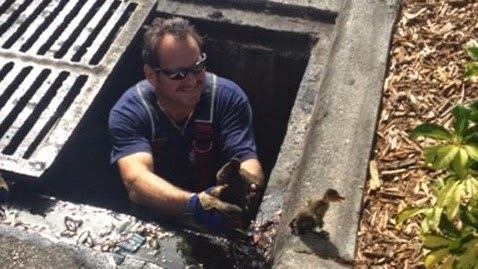
We started off early with a trip to the grocery store to get our dinner shopping out of the way. As we returned to the engine we were approached by a man who asked us if we wanted to save some ducks. We asked what he meant and he told us that some ducklings had fallen into the storm drain through a grate in the parking lot.
We followed him over and sure enough there were three cheeping ducklings down in the drain and no momma duck around. So we pried up the grate and dropped a firefighter down. She scooped up the ducklings one at a time and handed them up to us where they were placed in a cardboard box.
The plan was to bring the box of ducks to the local animal shelter but as we returned to the rig we spotted the mother and the rest of the duckling off in the bushes the next aisle over. I headed that way and of course they started waddling away. I got within a few feet and let the babies out of the box. They quickly fell in line with the rest and waddled off. Cue Paul Simon's Mother And Child Reunion.
We started off early with a trip to the grocery store to get our dinner shopping out of the way. As we returned to the engine we were approached by a man who asked us if we wanted to save some ducks. We asked what he meant and he told us that some ducklings had fallen into the storm drain through a grate in the parking lot.
We followed him over and sure enough there were three cheeping ducklings down in the drain and no momma duck around. So we pried up the grate and dropped a firefighter down. She scooped up the ducklings one at a time and handed them up to us where they were placed in a cardboard box.
The plan was to bring the box of ducks to the local animal shelter but as we returned to the rig we spotted the mother and the rest of the duckling off in the bushes the next aisle over. I headed that way and of course they started waddling away. I got within a few feet and let the babies out of the box. They quickly fell in line with the rest and waddled off. Cue Paul Simon's Mother And Child Reunion.
We returned to the station having done our good deed for the day.
Our next call though wasn't as cheery.
We got toned out for a traffic collision not too far from the station. It came in as a truck into a pole. Based on the location of the incident we figured it wouldn't be that bad because it wasn't an area in which you would normally be moving at a high rate of speed. But, we got several updates during the short trip to the scene, each one worse news.
Update. Vehicle is on it's side.
Update: Female pt trapped in vehicle.
Update: Pt may be in cardiac arrest trapped inside the vehicle.
On arrival we saw a pickup truck head on into a tree, on its wheels but listing to the side due to the impact. We also saw cpr being performed on a man on the ground. So much for accurate information.
Well, we were quickly informed that this was the only patient (no woman involved) and that the truck had been on it's side before the crowd of 25 on lookers decided to push the thing upright and drag the driver out to begin cpr.
We took over cpr and started doing our thing. It was pretty evident early on that this was a massive cardiac event that led to the crash and not a traumatic arrest as a result of the crash. We got all the pertinent medical procedures done, Lucas device attached, IV access, intubation, and meds on board. The patient was in asystole from the get go and never came out of it. We determined death in the field after three rounds of drugs failed to have any effect.
We covered the body with a highway blanket and left the scene with the cops to wait for the coroner then returned home where I made enchiladas for dinner and the white board by the table displayed three crudely drawn ducklings next to my firefighters name. You take the wins where you can.
Wednesday, April 9, 2014
Heart Stopper
There is an abnormal heart rhythm known as SVT (supra ventricular tachycardia) that is potentially very serious. This rhythm is very rapid and requires a huge amount of work by the heart to maintain. There are a variety of ways to combat SVT, with and without medications, and in the case of someone whose body is no longer compensating for the extra workload on the heart we treat it with electricity. We didn't have to go that far this time fortunately.
We responded to a call for a 65 year old female with a rapid heart rate. When we arrived this woman was sitting in a chair telling us that she has a history of SVT and has tried valsalva maneuvers, a cold shower, relaxation and nothing has brought her heart rate down and now she is getting really tired. Her heart was racing at about 220 beats per minute. She said this had been going on for about three hours now. Yeah, no wonder she was tired. That's like running a marathon. She immediately asked if we carried Adenosine (the ant- arrhythmic drug we use to combat SVT) on the truck, so she knew her stuff and knew what was going to happen next. She wasn't happy about it though.
We laid her down on the floor and established an IV so we could administer the Adenosine. Adenosine causes a transient (brief) heart block in the AV node (pacemaker) of the heart causing a cessation of the irritability and allows the heart to essentially reset itself. In layman's terms: we stop their heart and hope it fixes itself.
We generally don't explain it to people that way of course because that is just a little bit alarming. We also don't tell them how horrible it feels when it is administered. Imagine going from 220 bpm to 0 in a couple seconds. It's like your heart hit a brick wall in a Ferrari. We usually say, "This may be uncomfortable for a minute". This lady knew what was coming and asked me to hold her hand when we did it. Fortunately I have a two medic crew and was able to do my part and hold her hand at the same time. Adenosine is so fast acting and has such a short half life that it has to be pushed rapidly as close to the IV site as possible and immediately followed with a saline push from the next available port in the IV line. So, two syringes pushed one after the other into the IV line. My firefighter pushed the drug and I pushed the saline as this woman tried to break my fingers with her kung fu grip. I watched the monitor as the time ticked by, ten seconds, no change, fifteen seconds, no change. Damn. I guess we will have to go to a second dose. But just then her grip tightened, which I didn't think was possible and she let out a painful moan. I watched the heart monitor drop from 220 down to about sixty and back to 120 and finally level off at about 94 bpm.
She said she could feel the slam of the Adenosine all the way through her body. It felt like hell, but it worked. The ambulance arrived just as we were finishing pushing the meds. We had the IV done, drugs administered, and rhythm converted for them which just left them transport to the hospital where our patient would be monitored for a few hours to make sure her heart remains stable. Sorry guys.
We responded to a call for a 65 year old female with a rapid heart rate. When we arrived this woman was sitting in a chair telling us that she has a history of SVT and has tried valsalva maneuvers, a cold shower, relaxation and nothing has brought her heart rate down and now she is getting really tired. Her heart was racing at about 220 beats per minute. She said this had been going on for about three hours now. Yeah, no wonder she was tired. That's like running a marathon. She immediately asked if we carried Adenosine (the ant- arrhythmic drug we use to combat SVT) on the truck, so she knew her stuff and knew what was going to happen next. She wasn't happy about it though.
We laid her down on the floor and established an IV so we could administer the Adenosine. Adenosine causes a transient (brief) heart block in the AV node (pacemaker) of the heart causing a cessation of the irritability and allows the heart to essentially reset itself. In layman's terms: we stop their heart and hope it fixes itself.
We generally don't explain it to people that way of course because that is just a little bit alarming. We also don't tell them how horrible it feels when it is administered. Imagine going from 220 bpm to 0 in a couple seconds. It's like your heart hit a brick wall in a Ferrari. We usually say, "This may be uncomfortable for a minute". This lady knew what was coming and asked me to hold her hand when we did it. Fortunately I have a two medic crew and was able to do my part and hold her hand at the same time. Adenosine is so fast acting and has such a short half life that it has to be pushed rapidly as close to the IV site as possible and immediately followed with a saline push from the next available port in the IV line. So, two syringes pushed one after the other into the IV line. My firefighter pushed the drug and I pushed the saline as this woman tried to break my fingers with her kung fu grip. I watched the monitor as the time ticked by, ten seconds, no change, fifteen seconds, no change. Damn. I guess we will have to go to a second dose. But just then her grip tightened, which I didn't think was possible and she let out a painful moan. I watched the heart monitor drop from 220 down to about sixty and back to 120 and finally level off at about 94 bpm.
She said she could feel the slam of the Adenosine all the way through her body. It felt like hell, but it worked. The ambulance arrived just as we were finishing pushing the meds. We had the IV done, drugs administered, and rhythm converted for them which just left them transport to the hospital where our patient would be monitored for a few hours to make sure her heart remains stable. Sorry guys.
Subscribe to:
Posts (Atom)